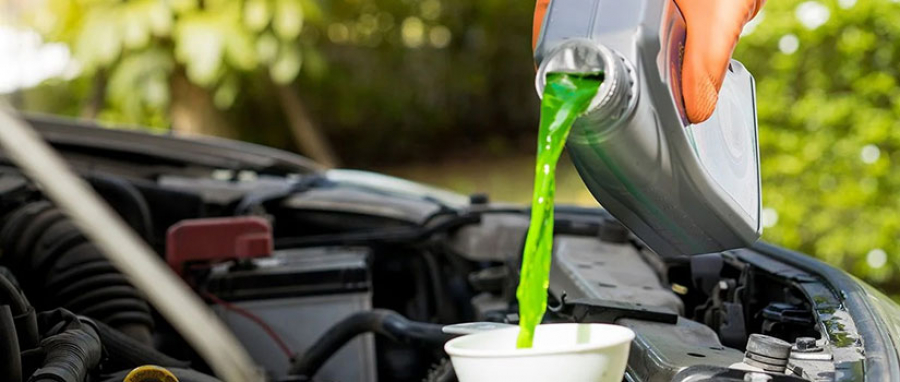
Antifreeze (from Greek anti — against and English freeze — to freeze) — liquids that freeze at low temperatures, used in systems operating at low temperatures, as well as for cooling gasoline and diesel engines.
Mixtures of monoethylene glycol, propylene glycol, glycerin, alcohols, and other substances with water are used as antifreezes. Antifreezes contain packages of anti-corrosive, anti-foam, and anti-cavitation additives.
Coolant "Antifreeze -36"
A ready-to-use all-season coolant (green in color) for cooling systems of all types of passenger and commercial vehicle engines. Temperature range from -36°C to +118°C. Made from high-grade monoethylene glycol. Contains high-quality corrosion inhibitors. Can be used in all engines where the manufacturer refers to the ASTM D3306 and BS6580 standards in specifications. Compatible with all types of coolants made from monoethylene glycol. Meets G11 requirements.
Coolant "Antifreeze -38"
A ready-to-use all-season coolant (red in color) for cooling systems of all types of passenger and commercial vehicle engines. Temperature range from -38°C to +135°C. Made from high-grade monoethylene glycol. Contains a highly effective package of anti-corrosive, anti-foam, anti-cavitation additives, and stabilizers. Does not contain nitrites, amines, phosphates, or silicates. Meets G12, B 0400240 requirements.
It is not recommended to mix with other types of antifreezes.
- Antifreezes contain lubricating and anti-foam additives that extend the life of the water pump bearing
- Protect the pump seal and rubber components of the cooling system from drying out, cracking, and leaks
- Contain powerful corrosion inhibitors for passivation and protection of metal parts of the cooling system
- Have high thermal conductivity, preventing the formation of "hot" spots in the cooling system and scale buildup
- Safe for plastics, rubber components, and paint coatings
The quality of antifreeze depends on the quality and quantity of additives used in its production. One of the signs of quality antifreeze is the presence of official approval and compliance with one of the foreign standards. For example, the American — ASTM D3306 and ASTM D4556, Belgian — BT-PS-606A, English — BS 6580, NATO S-759.
Antifreeze should be replaced if:
- the service life of the applied one exceeds the recommended (usually 5 years) - additives may lose their functions
- you have added ordinary water to the reservoir for a long time — increase in scale and neutralization of additives
- you bought a used car — not sure what has been poured into the system
- you used something other than antifreeze for the cooling system — save the car
- repair work has been carried out that involved opening and draining antifreeze from the cooling system
Replacing Antifreeze
- Drain the old coolant with the heater tap open (Attention! Do not open the radiator or expansion tank cap until the engine has cooled down!). Fill the cooling system with flushing liquid, flush it according to the instructions (usually 10-20 minutes). Allow the engine to cool and drain the liquid into a special container.
- Pour antifreeze into the cooling system. Start the engine and let it run until the thermostat opens. Turn off the engine.
- Bring the coolant level to normal
- When replacing antifreeze with the same brand, flushing the cooling system may not be necessary. However, if you are pouring in antifreeze of a different brand, the system must be flushed to avoid unpredictable interactions of additives of different compositions